
A previous version of me would cringe at the sight of a homage wristcheck. I couldn’t help but think, you poor thing. Now I think, you poor thing—who did this to you? Because the “who” behind a homage makes a difference. At least to me.
There’s no denying that watch culture treats homages as an unwanted guest. And for good reason. No originality. No craft. No heritage. Who would make such a thing, let alone buy it? The thought alone used to send shivers down my spine. And when a homage targets something sacred (which it almost always does), especially a watch as sacred as the Omega Speedmaster Moonwatch, well, now you’re just asking for trouble.
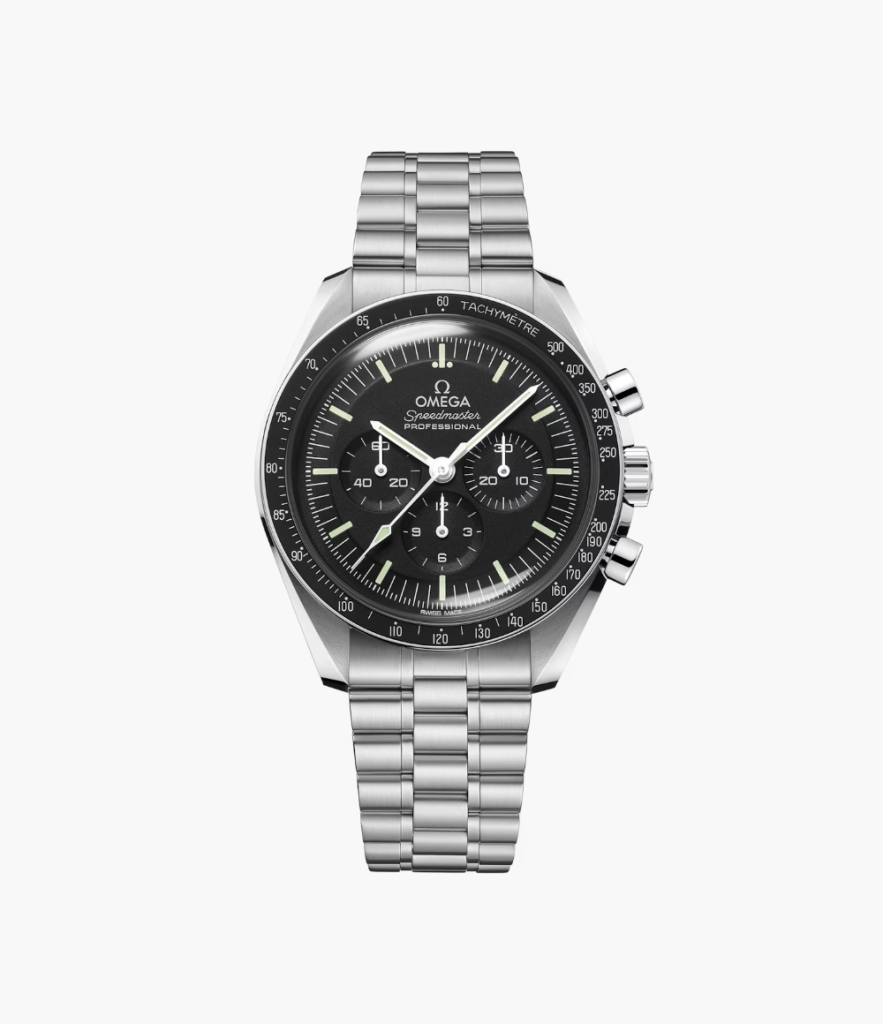
Omega Speedmaster Moonwatch. Prestige. History. NASA-certified legitimacy. You could say… it’s out of this world.
For the record, I don’t own a Moonwatch. But I was lucky enough to be graced with its presence for some time, thanks to a former colleague who wore it as his daily. Imagine that. Now imagine this: I held it. Once. He even let me try it on. And I have to admit, it really does have its own gravitational pull. I couldn’t help but stare at it, and rudely so. But I didn’t care. Just as I don’t care to ever own one. Am I a better person for it? Probably.
Still, even I have to ask: who in their right mind would dare clone the Moonwatch? A watch with heritage rooted in spaceflight, NASA testing, and human achievement? Ha! You can’t just copy that. There’s no shortcut on this cislunar voyage! And yet, that’s exactly what the MoonSwatch did.

MoonSwatch Mission to Mars. Plastic. Quartz. Bright colors. Crowds lined up outside malls to get this hunk of… bioceramic.
If you thought double-wristing was fun, try double branding. OMEGA x SWATCH. Same parent company. Completely different cultures. Two Swiss powerhouses coming together to defy the laws of loyalty.
On one side, you have the Speedy gatekeepers heaving at the sight of their holy grail getting the cereal-box-toy treatment. On the other, you have aspiring watch enthusiasts enjoying Omega’s flagship model as part of a complete homage: same case shape, same subdial layout, same tachymeter typography—dot over ninety included. All of it at a fraction of the price.
Just like that, the homage debate crumbled faster than the MoonSwatch’s bioceramic pushers. Because suddenly, you no longer needed to drop a whopping $8,000 to enjoy a piece of lunar legacy. Then again, maybe you never really did. After all, one notorious brand of haute horologie has been manufacturing its own “inspired” version of the Speedmaster for years.
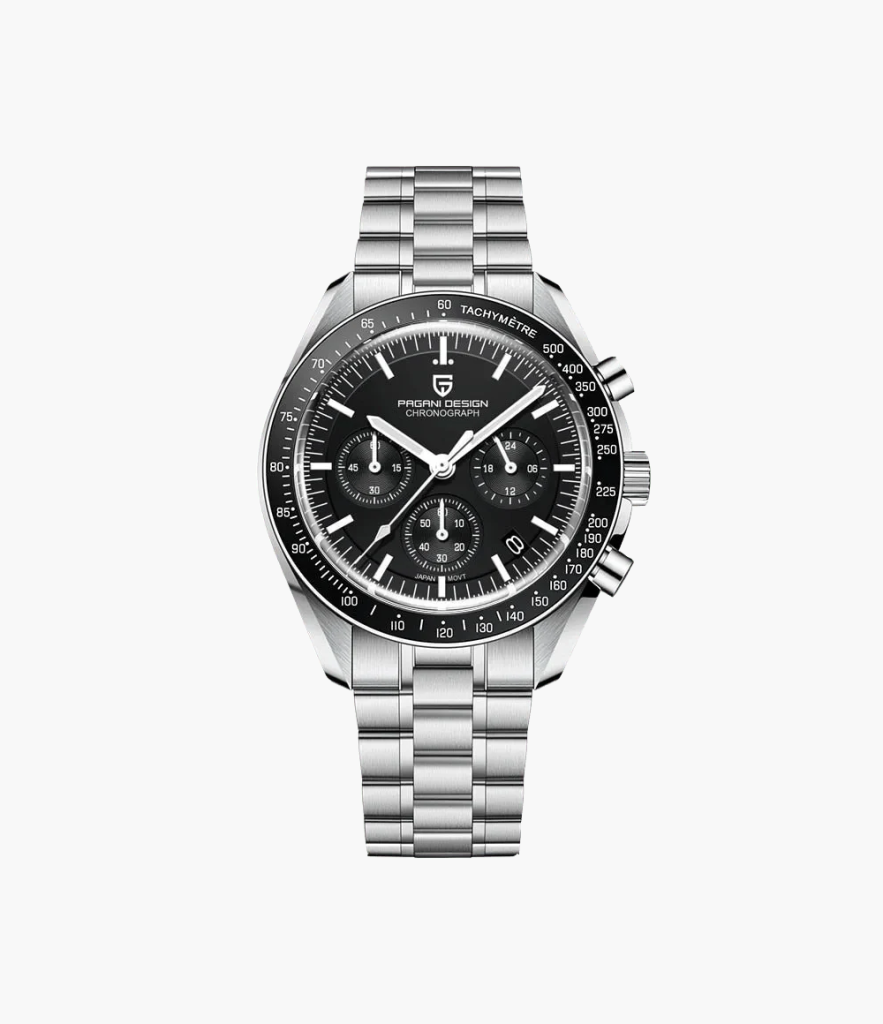
Pagani Design PD-1701. It has a date complication. *Laughs in snob.*
Enter the Pagani Design PD-1701. Sure, it’s got a measly 40mm diameter compared to the Moonwatch’s girthy 42mm. It lacks those caved-in subdials reminiscent of the moon craters you’ll never walk on. And yes, it has a date complication, which one could argue is actually practical. But most importantly, if you squint hard enough, you might convince yourself you’re wearing the real deal. And for a steal, too: $163.79. An oddly specific, yet very reasonable price to pay for an illusion.
But wait. It gets better. On paper, this Chinese homage offers an even more compelling package when compared to the MoonSwatch.

Also called Pagani Design PD-1701. The name is as unique as the watch itself. What do you expect from a homage of… a homage.
For the same money, the P. Diddy-1701 MoonSwatch homage gives you a meca-quartz movement, a steel case and bracelet, and sapphire crystal. Meanwhile, the MoonSwatch sets you back $285 for a basic quartz movement, a plastic—sorry, bioceramic—case (I’ll get it right eventually), biosourced glass (got it!), and a cheap strap that is almost universally hated. Ouch.
Despite all that, the Pagani Design homages suffer from one fatal flaw. They lack the one thing that propelled the MoonSwatch to stardom: Omega’s stamped seal of approval. And that’s what this really comes down to. One has permission. The other doesn’t. One is a playful, official homage with Omega’s blessing. The other is a cheap Chinese knockoff. That’s the premium you’re paying for. One small step for aspiring watch enthusiasts. One giant leap for Swatch Group.
So when I asked earlier who did this to you, that’s what I meant. Because if Omega does it, it’s okay. It’s sanctioned by the highest authorities in Swiss watchmaking. If Pagani Design does it, it becomes a close encounter of the turd kind.
But hey, here’s the thing Pagani Design and its fellow offending comrades have going for them: they broaden access to joy. And that counts for something. I have no doubt enthusiasts know exactly what they’re wearing. They’re not flexing. They’re not faking. They’re just appreciating—in their own way. And that’s fine by me.
We’re all guilty of buying into illusions anyway. I’m a marketer; I’d know. And I’d be lying if I said I didn’t love every bit of it. When a watch has heritage, we buy the story. And that’s okay. It’s fun. Just as some buy into the illusion that Pagani is Omega, others buy into the illusion that man, and by extension the Speedmaster, went to the moon. But as they say—and by they, I mean me—the bigger the illusion, the bigger the price tag. To quote Voltaire: “Illusion is the first of all pleasures.”
Some illusions just cost more than others.