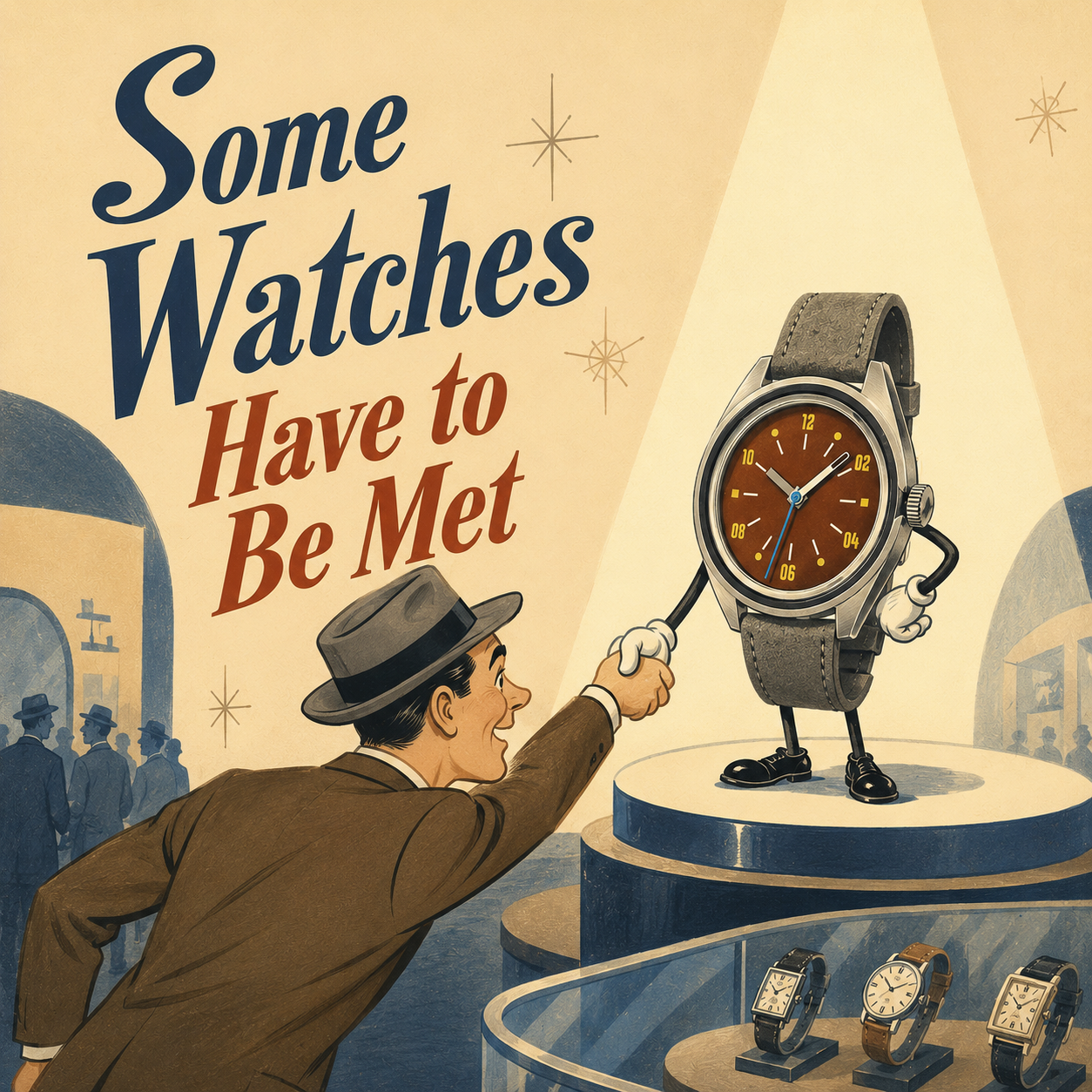
I debated going to my first-ever watch show, which also happened to be the first Montreal Timepiece Show. I didn’t have much to base my decision on other than the list of brands sponsoring the event, half of which I didn’t recognize. Most of them were microbrands, which have never really been my thing. Still, the chance to get my hands on watches I’d never see at my local AD was tempting.
With a 30 bar dive watch on my wrist, I dove headfirst into my laptop, looking up each brand I didn’t know, exploring everything from price and movement to heritage. Yes, even heritage, for a microbrand. Give me something—anything—even if it’s as lackluster as the founder’s great-great-grandfather taking a hike on some Swiss mountain over a century ago. If it has a backstory involving Switzerland, nature, and physical exertion, it just might have my money. Or so I thought.
Speaking of money, the tickets were free, so what the heck.
Less than a minute into the showroom, I was reminded of the same dilemma I’d had before walking through the doors. The very first booth belonged to a Montreal-based watchmaker showcasing a dial made of leather. I “oooh”‘d and “aaah”‘d as I ran my fingers across the quilted Italian lambskin. Don’t get me wrong—the watch was cool. Just not $2,000 cool.
Dropping two grand on an unknown brand had always been a hard sell, especially when the same money could buy me an entry-level luxury watch from the usual suspects. Yes, I know—economics of scale and all—but for that kind of money, I want to be reassured. What am I paying for? What movement does it use? Does it have a story? Maybe it’s unfair to expect so much from a microbrand, but I’ve been coddled by Swiss and Japanese multinationals for far too long. I hoped to God (the venue was a repurposed church, after all) this wasn’t a sign of things to come. As I wandered from booth to booth, however, I slowly realized I’d been judging these watches by the wrong criteria.
Funny enough, I had no idea Paulin would be exhibiting. I’d been eyeing their Modul B Quartz for months, so finally getting to try it on felt like a dream come true. At first, I was underwhelmed by how light it felt. Granted, I’d just taken a hefty 14 mm-thick Marathon diver for a spin, but everything else about the Modul B Quartz just… made me happy: the vibrant yet unconventional colors, the bespoke in-house typeface, the minute hand cutout landing perfectly above each hour marker, and perhaps my favorite detail of all, the quartz movement displayed through an exhibition caseback.
At that point, price, movement, and heritage all belonged to a version of me that had faded away about twenty booths ago. For the first time, I found myself appreciating the little things no one else was doing, whether it was Paulin’s postmodernist “Wim” font, Isotope’s “hyperbolic paraboloid” crystal, Worden’s brutalist-inspired case, or, heck, even José Cermeño’s hand-stitched leather dial.
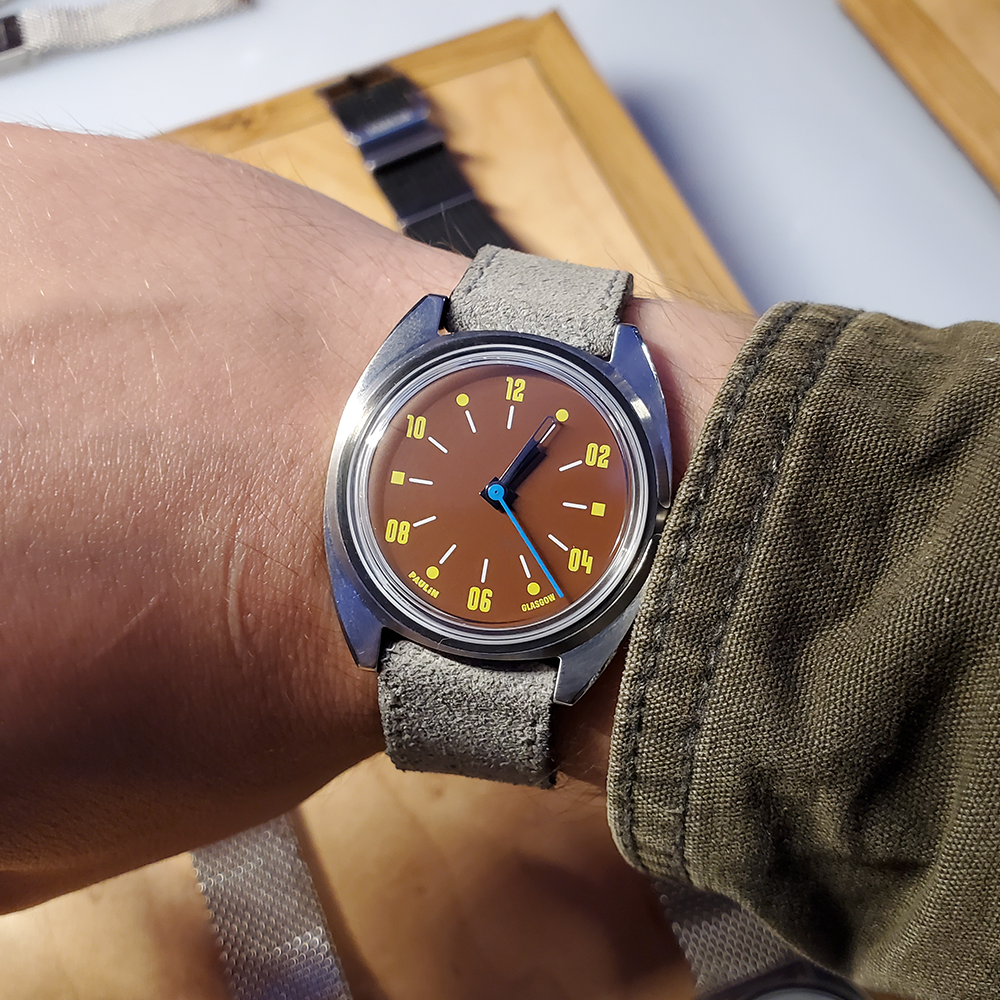
My coup de cœur of the Montreal Timepiece Show: the Paulin Modul B Quartz. Pro tip: wear your own watch on the opposite wrist so you can try every other watch on your preferred one. I learned that one a little late.
In the end, I didn’t leave with the Modul B Quartz—anticlimactic, I know—but only because they weren’t selling it on site. Still, I came out of there with something you couldn’t buy: I learned that all the specs and pics in the world won’t do a watch justice. You can spend countless hours watching Teddy Baldassare and reading Hodinkee or Fratello, but none of that can tell you what a watch does to you once it’s on your wrist.
But the watches were only part of the experience.
When you’re physically there, talking directly to the founder, designer, janitor—whoever—you’ll hear stories and details you’d never get researching online, like how I discovered that Paulin engraves a maple leaf on the Modul B Quartz caseback as a Canadian exclusivité, pardon my French, for Roldorf & Co.—the only authorized Paulin dealer in Canada—which assembles them in Vancouver. I know, it’s not “Italian lambskin” level cool, but to me it is.
Little details like that don’t just bring you closer to the watch itself—they bring you closer to the community behind it. The exhibitors were knowledgeable, welcoming, and genuinely happy to talk watches. Event goers were equally easy-going and respectful, with the exception of a small elderly Russian woman who shoved me, cut in line, and I’m pretty sure did the same to several other people.
What surprised me most, though, was just how much trust there was on both sides of the booth. You could simply pick up any watch without asking permission. Well, almost. There is, of course, some etiquette to follow: approach the booth, take in the collection, smile at the exhibitor, and reach for the watch that catches your eye. It goes without saying that your behavior should resemble that of a civilized human being instead of a certain babushka.
Otherwise, you’re free to try on as many watches as you like—something your local AD would never entertain. Instead, they’ll pull out one watch at a time, usually from the same old mainstream brands everyone else seems to carry. Yawn. Just kidding. I haven’t become a microbrand hipster. Yet. But you get my point: in a single afternoon, you can turn months of online research into firsthand—or should I say, firstwrist—experience.
So, if you’re debating whether to go to a watch show, do yourself a favor and go. Some watches simply have to be met. If you’re like me, you may think you know a watch based on its price, movement, and heritage, but until you’ve seen it, held it, and worn it, you don’t really know it at all.